I make references to things and if you catch them, good for you.
This is a school blog, so I will be scholarly. I will still have personality, though.
Allons-y!
"Adult Parties and Why I Hate Them": I went to another adult party yesterday. After reading The Catcher in the Rye, I know exactly how to describe the way I feel. They are all PHONIES. I cannot stand it. I do not want to become that. I resent the phoniness. Yet it somehow feels as if there is no way to become an adult without embracing the phoniness. I really feel like Holden. I do not want to be a child, but I do not want to be a phony. Why are sincerity and sensitivity childish?
"Music that I Like": The Hobbit soundtrack. Radagast the Brown, The Hidden Valley, and The Adventure Begins are some good tracks. Also, the Game of Thrones main theme is ear candy.
"My Dog": I look back on that post with a sad sort of irony.
"Rowing Crew: Parts 1,2, & 3": Wow, those posts were long. They're where I got a lot of my views. Apparently people are quite interested in how rowing works. Maybe that's because it doesn't get a lot of coverage in the mainstream media. Hmm. There was a Mythbusters episode featuring crew, though! They were testing if you could waterski behind an eight. Spoiler: you can!
"Sexism in the Media": I would really love to delve into feminism in A Song of Ice and Fire/Game of Thrones. It takes place in a very sexist setting, but there are so many strong female characters in so many different roles. (Can you say Brienne of Tarth, Arya Stark, Sansa Stark, Catelyn Stark, the Sand Snakes, Cersei Lannister, and especially DAENERYS TARGARYEN, Daenerys Stormborn, Khaleesi of the Dothraki, the Unburnt, Mother of Dragons?) It makes me really happy and I highly recommend the series. You know what? I'm going to do a post about just Daenerys next week. Just because I can and just because she is so awesome.
"High School is Awful": This continues to be a true statement. I am so done with school. I cannot wait for summer break.
"Homestuck": To clarify, the goal of the game is to create a new universe by breeding the Genesis Frog. Defeating the denizen is necessary to advance to the seventh gate, and advancing to the seventh gate and Skaia is necessary to defeat the Black King & Queen, who are bent on destroying the Genesis Frog. Reaching godtier is not necessarily a goal of the game but is highly useful. Also, a warning: Homophobes beware Homestuck. The most successful ship right now is two girls, one troll and one human. (Rose/Kanaya <3 OTP) Troll culture does not even have a word for homosexuality.
"Cosplay for Those Who've Never Heard the Word": There are so many great cosplays out there, and people love to post pictures of themselves in their cosplays. Is there a character you like? Chances are there's a cosplay of that character out there somewhere. Google it. Also, if you like cosplaying, I encourage you to try roleplaying. It sounds dumb and so stereotypically nerdy but it's basically just improv acting, and if you can find other people to roleplay with, that makes it so much fun.
"The Castle: A Fairy Tale": Sorry, but I probably won't post the ending to this. I'm sort of taking it in a direction that I do not think is appropriate for this blog. If you want to take this idea and run with it in your own direction, go ahead! Just let me know in a comment or something.
"Shakespeare Wrote the Best Romantic Comedies": Still true. Though as a second best, there's a trailer out there for a (nonexistent) retelling of Harry Potter and the Half-Blood Prince as a romantic comedy and it's pretty hilarious. Mostly it's hilarious because that book was the most romcom-like of all the Harry Potter books.
I hope some or all of that was useful or interesting.
Next week I fangirl about Daenerys Targaryen because KHALEESI.
The alarm clock glows blue with the ungodly numbers 5:30. It's time to get up. It's a Saturday or Sunday morning, and while most of your friends may be asleep for the next few hours, you stand up. Today is a regatta. This is a day you've been training for since the beginning of the season.
You walk to your dresser and pull out a racing tank with the team logo on it and a pair of spandex shorts. It's cold this morning, so you throw on your windbreaker with the team name blazoned across the back and your team sweatpants over your racing gear. A pair of clean socks and your old, worn sneakers cover your feet.
In a drawstring bag, you bring a blanket, sunscreen, sunglasses, a water bottle, and some homework that you probably won't get around to doing. You bring it anyway.
Your hair is up in a ponytail or bun, if you have long hair. You put your iPod and cell phone in your front jacket pocket and grab the lightest of breakfasts. There will be more food once you get there.
A parent drives you to the regatta at some river or another. The sun has only recently come up, and it is cold and windy. You walk to the team tent and drop off your stuff, then head to the trailer to unload and rig the boats.
After a nerve-wracking episode in which the heaviest boat almost fell off from the top rack, and after fifteen minutes of scurrying around with a 7/16" wrench fastening all the riggers to the boats, the team heads back to the tents. The waiting begins.
Everyone brought blankets. People cuddle and snuggle in a great pile under the shelter of the wall-less tent. Some nap. Some discuss the races. You halfheartedly take out your homework, but you don't really want to work on that right now. Strange conversations are struck up. A boat's worth of rowers gets up to row in the first race. You cheer them on as they walk off, then go back to your conversation.
About a half-hour later, a parent or coach or someone will announce that the boat that left earlier is racing. You and the rest of the team go down to the edge of the river to watch.
The river is a broad expanse of choppy water, marked here and there by a buoy or two. Four long, spidery boats propel themselves downriver towards you at maximum speed, oars turning and pushing together in one single stroke, then coming up for another in another two seconds or less. The oars occasionally skim the water. Oarlocks clack as one entity per boat. The coxswains are yelling unintelligibly at their rowers. The boat from your team is in second place. Your team strikes up a cheer: One, two, BLAIR CREW! One, two, BLAIR CREW! The boat passes the finish line in second place. Not bad. As the coxswain tells them to relax, even from the river's edge you can see them slump. A race takes a lot out of a rower.
You walk back to the tent for more huddling under blankets. It's less than two hours before your race, so you're not allowed to eat any of the delicious food on the tables next to you. Wait until after your race, when you're hungrier and you've earned it.
A little less than an hour before your race, the coach calls your boat to go get ready to race. You peel off your jacket and sweatpants, make sure you've had an adequate cover of sunscreen, and jog to where the boats wait in slings. You check your heel ties, your oarlock height, your shoe stretcher distance. The rowers and coxswain of your boat go in for a team huddle. The coxswain or stroke seat gives a motivational speech. You go over your strategies for power tens, when the sprint will start, and what the coxswain should say. Finally, everyone walks to the boat and, under the coxswain's command, walks the boat to the dock.
Docking is even faster than usual. To minimize extra weight in the boat, no one brings water bottles. A parent grabs shoes and puts them in a bag to await rowers upon their return. Once everyone's ready, you sit in the boat and push off. Bow pair rows away from the dock to make room for the next boat. You practice drills and show off for the other teams on the way up to the starting line, perhaps stopping and practicing your racing starts. Finally, an official calls the coxswain and directs them to the correct lane.
Your stomach is in knots. Your adrenaline is pumping. You're at the three-quarters slide, ready to go right into the start. Your eyes are in front of you, and your ears are tuned for the two magic words. This is it.
"Attention... "Row!"
The coxswain's voice takes over your mind. "Three quarters! Half! Three quarters! Full! Full! POWER TEN! ONE... TWO... THREE... FOUR.. FIVE... SIX.. SEVEN... EIGHT... NINE... TEN... LENGTHEN TEN! ONE... TWO..."
There is nothing but you, your fellow rowers, the coxswain's voice, and your oars pulling through the water. You push as hard as you can with your legs, your arms, your back, your abs. Everything counts. You focus on keeping the boat set - catching a crab could pull you to last place. You push off your foot stretchers, pull with your body, keep in time with stroke seat and your pair partner.
The initial adrenaline wears off. You are more aware of the boats to either side of you, but you dare not look. The coxswain calls out their locations relative you your boat, and that is not good enough, but you make do. You have to keep up maximum power without draining yourself too much. You have to save something for the sprint.
The race continues for three more minutes like this, at thirty strokes per minute. Someone behind you is grunting with pain and exertion. You are internally screaming.
Then you reach the last quarter of the race. The coxswain tells you to prepare for the sprint. While a quarter of your brain is shouting in alarm and another quarter gives up, the remaining half reminds you to perfect your technique, sit up straight, breathe properly. You have to leave the other teams behind in the sprint.
The coxswain calls the sprint. She yells and yells and yells, reminding all the rowers of everything they're doing, right and wrong, and reporting the location of the other boats. You leave everything behind here, pulling as hard as your muscles will let you.
Your brain quietly informs your body that you are going to die. Your heart screams back, "SO F***ING WHAT?"
You see a boat pull forward out of your peripheral vision. Oh hell no. You add an extra burst of speed. Luckily, so does the rest of the boat, and you pull forward just in time.
You cross the finish line.
"And, paddle!"
There is no paddling. There is only slouching on the oars, gasping for breath and wishing for water. What place did we come in? Second, the coxswain says. Second is fine. You'll take second. But you still berate yourself, because you could have made first.
An exhausted boat steers around towards the dock. You call "good race" to a neighboring boat, in which all the rowers look as tired as you feel. Someone calls the same back to you, managing a smile. Finally, you pull in against the dock, with enough energy gained from the brief rest to roll the boat over your head and walk it back to the slings.
You walk to the tent and stuff your face with water and food. You drape a blanket over your shoulders and eat. You've done well today. It's all easy going from here.
The rest of the boats race. The girls' varsity eight wins their heat. Of course they do.
The regatta winds down. You walk around, maybe buy the official regatta t-shirt. You de-rig and load the boats onto the trailer. You'll rig them again at practice on Monday. For now, you can go home.
You say good-bye to your friends and head to the car with your parent. It's been a good day overall. You're probably sunburned, but who cares? You had fun.
In the end, that's what keeps you coming back the next week and the next, to different boathouses on different rivers in different cities. You had fun.
"All hands on the Trailblazer!" "Are all the oars down?" "Up and over heads, ready, up!" "Weighenough!" "Hurry up on the dock!" "Coach, my coxbox isn't working." Part two will be a run-through of a typical on-the-water practice! The bell rings at 3:00. Those who got out at 2:10, already changed, head outside to the one school bus parked perpendicular to the rest and on the other side of the parking lot. Those who get out at 3:00 dash to the bus before it leaves, planning to change once at the boathouse. The bus is always too full. The last few to arrive are relegated to a helpful parent or senior rower's car. After a half-hour bus ride full of the craziest conversations, we arrive at the boathouse. The boathouse is at a park in an industrial town. The river goes under a bridge before coming to a wide, shallow area perfect for launching kayaks, canoes, skullers and shells. The boathouse itself has a small bathroom for both sexes, an office, and the large room often referred to by itself as "the boathouse." Several long, tall racks fit six Eights on each side. To reach the top racks, we use industrial lifts (think Genie brand).
This isn't our boathouse, but it is similar. We even have a few boats that look exactly like those yellow ones.
When we arrive at the boathouse, those who get out at 3:00 from school go to change in the bathrooms. Once ready, we run to and from the gate of the park as a warmup. Then we check the whiteboard for the lineups of the day. Thanks to variable turnout, the lineups change from day to day. The coaches often have to get creative. Several rowers double as coxswains, and a few bisweptuals flip sides day to day. We're always short a few ports, it seems. On the whiteboards, the rowers, their seats, the coxswains, the oars, and the name of each boat are put into a handy reference for the day. Rowers get oars from their places at the back of the boathouse. Usually we need all the oars. Twice this season we've been short a few oars, and the rowers of a four have to stay on land. The oars are in sets, by handles. Some have orange tape around them near the blades; some have purple wrappings around the handles; most are identified by the tape just above the handles. Each boat has a set. Oars are propped up on a railing overlooking the river and a few feet from the dock. The sets are together in clumps, and if someone does it right they are put in pairs, one starboard and one port, within the clumps. Coxswains shout the name of the boat they're coxing to get their rowers' attentions. Our eights are the Trailblazer, the Blazing Paddles, the Tsunami, and the Blitzkrieg. It's common for boats to have "fierce" names like that, sort of like it's common to have "fierce" mascots like tigers, eagles, or bears. Then again, like some mascots are socks or rockets, some boats have more pleasant names, like the Charlie, one of our fours. "All hands on the Blazing Paddles!" And eight rowers walk to the boathouse, where we may or may not have to wait for another team to get their boats out first. Two rowers get the lifts, one in the bow and one in the stern. All eight carry the boat on our shoulders down to a ramp, where we have to go over heads due to its narrow width. Often the dock, which can only hold two boats at a time, has a line of boats coming up the ramp and across the parking lot to the boathouse. Waiting while holding the boat is annoying, as we hold it at waist height ("Down to waists, ready, down!") and it tires out our arms. Meanwhile, the coaches are setting up small, simple motorboats filled with life jackets, a canoe paddle, and a megaphone. Extra rowers get sent to the launches, as the boats are called. Rowers in the launch effectively get half a day off, and switch in sometime during the row. Usually. Sometimes the coaches just never meet up with the right boat, and a rower gets a whole day off. Eventually we get the boat into the water. The coxswain calls one side to get oars, the other side to get oarlocks. ("Ports get oars!") The oarlocks, as you remember from my previous post, hold the oar in place. The side that stays behind unlocks and opens the oarlocks, puts their shoes in the boat, grabs waterbottles, and etc. The side that goes to get oars grabs a pair, one for themselves and one for their pair partner. Once all the oars are in place (with the oars that would be out on the water pulled as close to the dock as possible, to keep it balanced), the coxswain steps in ("Hold for the coxswain!"). He/she plugs the coxbox in and tests it to see if everyone can hear. By now, everyone is standing next to their seats, with their shoes off and in the boat already. The oars that go out to the water are pushed out ("Ports, oars out on the water!"). The coxswain calls again: "One foot in, and, in!" At the coxswain's call, all eight rowers step into the boat, one foot at a time. Velcro and shoelaces are tightened, oars held, shoes stowed away. "Count down from bow when ready!" "Bow!" "Two!" "Three!" "Four!" "Five!" "Six!" "Seven!" "Eight!" "Push off the dock, and lean away!" Leaning away from the dock to balance the oars still on it, all eight rowers push off with their hands. This is usually complemented by two rowers on the dock side pushing with their oars; in our scenario, where the ports' oars are out to the water, the starboards' would be dockside, so Bow and Seven would push off. Bow pair usually rows the boat out to the main part of the river. Once we're all situated, we warm up. Our usual warmup is the pit drill, rowing by fours. "Bow four, arms only, row." After about twenty strokes, "In two strokes, arms and back, one, two." Another twenty. "In two strokes, half slides, one, two." Another twenty strokes. "In two strokes, full slides, one, two." Another twenty strokes, "And weighenough." Then the fours switch. Next comes an hour and a half of rowing, based on the workouts the coaches told the coxswains earlier. Today, in our hypothetical practice, the coach wants us to work on technique and keeping together. We row all eight for a while to get used to each other, then start some drills. There are far more boats than coaches, so the varsity girls usually get left to our own devices while the novices and boys get help from the coaches. The coxswain is effectively our coach for the practice. After a while of rowing, we hang out at a common turning-around wide area, about 1.5 Kilometers downriver. The coxswain, who has a sense of humor, is bantering with Three seat, who is jokingly complaining. "I like coxing soooo much better than rowing, [coxswain]! I'm so tired and I like bossing you guys around." The boat laughs. "Yeah, [Three]," says Eight, "I'm sure you do." "I do! It's so much fun." "You wanna cox? I haven't rowed in ages, not since sophomore year. Let's switch and see if the coach notices when he comes by!" "Yes!" After some discussion, gunnel-running is arranged. Two holds Three's oar. Three starts toward the stern, crouched, doing her best to avoid oars and to keep the boat from tipping over. She sits in Eight's lap while the Coxswain, jean-clad and clutching her phone, walks down the boat in a similar manner to the empty seat. She situates herself, and Three takes the microphone and speaks into the microphone. "Awesome! All right wimps, let's row." But it doesn't take long to realize that our coxswain has no idea how to row the way we do. We sit and chat for a while, until the coach checks up on us and immediately notices the switch. More rowing. The stress is on the legs, if you row correctly. Arms, back, shoulders, and abs also get their fair share of soreness. But that's easy to ignore compared to the blisters forming on palms and the sides of thumbs.
Typical rower hands. You can see a blister from feathering on the thumb. I'd venture a guess that this rower is a port, since (s)he feathers with the right hand.
And yet, through the pain, it is immense fun. The click of oarlocks in sync is one of the most beautiful sounds I've ever heard; the only thing that could rival it would be the TARDIS' vworp-vworp noise. The river, though polluted, is very scenic. Something about crew requires camaraderie unparalleled in any activity I've ever done. The little breaks we get and the conversations during them are hilarious and fun. Even the rowing itself is inexplicably enjoyable, as long as it's not a long power piece of awful terror and horror. The motion is fluid and natural, and knowing you're getting better and stronger is a lifting feeling. Finally, we come back to the dock. Docking is like getting out onto the water, but in reverse. There are only two changes this time: docking the boat, and cleaning it. A really good coxswain can dock without incident; unfortunately, ours are still getting the hang of it. It's difficult to judge the distance to go before turning. If the boat misses by too much, it takes forever to go sideways to the dock. If the boat doesn't turn enough and goes at a wrong angle, we could damage the bow ball or, even worse, the skeg. Carrying the boat is far more exhausting after a hard row than before. The coxswain runs ahead to grab boat slings, one for the bow and one for the stern. Rowers set the boat into the slings and disperse: some get oars, some grab the hose and sponges to rinse off the boat, a couple run off to have a moment's rest and conversation. When everyone's back and done with what they need to do, the rowers pick the boat up and put it back in the boathouse. Finally. Everyone's exhausted. Sometimes a coach will pull the rowers of one boat over for a talk. Sometimes the whole team meets up on a hill, next to the parking lot and only a hundred meters from a railroad (Yep. Industrial town, remember?), to stretch and cool down. More often, we just head straight to the bus and relax. The bus takes us back to school, where parents wait in minivans and Priuses to take us home. There you have it! One full rowing practice. Don't forget, the comments thread is open to queries and commentaries. I get a notification every time someone comments, so I will get back to you quickly.
"Oh yeah, I'm on crew." "Oh, like stage crew? What play is it?" "No, not stage crew. Rowing crew. The crew team. As in, boats and oars and such." "Oooh. I didn't know we had a rowing team."
This is another conversation I've had many times.
It's an Olympic sport, one that this year's American team won. It was featured in "The Social Network," when the main character was a coxswain. It has its own movie, "Backwards." But no one seems to know what crew is unless they have a friend on a rowing team.
Three days a week, I hop on a bus after school, filled with my teammates of all skill levels and both sexes. (I do say sexes and not genders here, Becca, but in this particular case they are synonymous.) We head down to a local river, take out our 64-foot-long, 2-foot-wide boats, and row. Well, it's not quite that simple - and I'm going to give you all the inside details of a day of rowing, and a regatta.
First, I will need to explain the mechanics of a boat, also called a Shell. It's called this for its hollow, thin, hard qualities that are necessary for rowers to be safe and to still be able to carry the boat between the water and the boathouse.
We'll go from bow to stern in the average boat: a port-rigged Eight. As you can see from the diagram, there are eight rowers and the sternmost rower (aka Eight seat or Stroke seat)'s oar is to port. Hence, port-rigged Eight. With me so far? No? Yes? Good.
Just in case you didn't know, this is important for the rest of this post: bow = front, stern = back, port = left, starboard = right. We say port, starboard, bow, and stern because rowers sit backwards and what is left to coxswains is right to rowers, etc. So when I say "We'll go from bow to stern," it means "we'll go from front to back." Got it? Yes? Good.
The first seat from bow to stern is called Bow seat. This is to avoid confusion that may arise from saying "have One seat take a stroke":
Ok, one seat, but that could mean any seat. Which one? OHH that one seat. Right.
"Bow seat" is much clearer. Bow seat is a starboard rower, meaning his/her oar is out to the starboard side of the boat. He/she will require a starboard oar. Bow seat follows Two seat. When I say "follow," I mean Bow seat watches Two seat's rhythm and matches it as closely as possible, going to each position of the stroke at the same time. The key to rowing is keeping together, "in sync," if you will.
The next seat is Two seat. Two is a port, meaning his/her oar goes to the - you guessed it! - port side of the boat. He/she will require a - altogether now - port oar. Two seat follows Three seat.
Detecting a pattern? Good, because that's exactly how it goes all the way down the boat. Odd numbers (including Bow) are starboard, even numbers are ports. You would think it would make the boat hard to steer, with all of the starboard oars behind the port ones, and indeed it does look off-balance at first glance. But the placement of all the starboard oars behind each one's port partner does absolutely nothing to the steering. This is because the extra power to port in the stern is counterbalanced by the extra power to starboard in the bow. It all works out nicely.
That reminds me, rowers/oars/seats are organized by pair: Bow/2, 3/4, 5/6, 7/Stroke. Bow/2 is also called "bow pair," and 7/Stroke is also called "stern pair." If you have Bow-4 rowing, that's "bow four"; 5-Stroke, "stern four." Bow-6 is "bow six," 3-Stroke is "stern six." To have people in the middle rest, the coxswain would call combinations of these: "stern four and bow pair, row" or "bow four and stern pair, row" or simply "five and six, sit out."
Likewise, the other rower in a pair is the first rower's "pair partner." For example, I am five seat, so six is my pair partner. I am six's pair partner.
Back to the tour of the boat! Eight seat is also known as Stroke seat. Rowers sit backwards in the boat, so to the rowers, Stroke is in the front. Stroke seat sets the pace or rhythm - the stroke - for everyone in the boat.
Another useful diagram! These are the stages of the stroke. The catch and the finish, aka the release, are points, while the drive and recovery, aka the slide, are processes. The entire time going from the catch to the finish is the drive, and the entire time going from the finish to the catch is the recovery/slide.
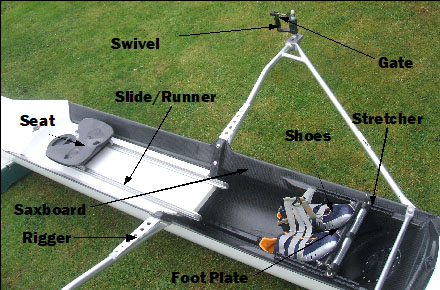
But wait, why and how are that diagram's stick figure's legs extending? Rowing is with your arms, right? Wrong. Rowers' feet are strapped into a shoe stretcher low in the boat. Our seats slide on tracks on a platform a little higher up.
The only things that are relevant here are the seat and the shoes/stretcher. Come back to this later, though, if you need to for other parts of the boat.
In this picture, you can see how the shoes are set low, under the platform where the seat is. Going back to the stroke diagram, you can see how the feet stay still while the seat slides. This allows rowers to take advantage of humans' strongest muscles for the drive - our leg muscles, which work constantly against the force of gravity and are biologically the strongest voluntary muscles in the human body. The main force comes from the legs, then a little bit from the back as we swing into the release, and just less than that from the arms. People seem to think that rowing is all upper body strength - "Oh, you row? You must have really strong arms!" - but really, it's all in the legs. Arms are just there to hold the oar and to feather.
Feathering is the rotation of the oar to minimize wind resistance. At the catch, the oars drop into the water, squared against the surface of the water to get maximum force. They stay that way through the drive, while the oars are in the water. At the release, when the oars come out of the water, rowers rotate the oars to parallel the water as we come up the recovery, or "slide." Going up the slide, rowers gradually square up the blades of the oars, finding the right balance between minimum wind resistance and minimum delay at the catch. Finally, at the catch, the blade is completely square again to restart the cycle. That entire process is called feathering. There's also rowing on the square, which is for warming up and brand-new novices only, because it causes a lot of splashing, wind resistance, and makes it harder to row in general.
One more note: feathering is with the inside hand only. The outside hand lets the oar rotate inside its grip. If the outside hand rotates as much as the inside hand, the outside wrist will get too tired too quickly. It's hard at first to feather with one hand, but it's much easier in the long run.
At last, we've reached the stern! The coxswain sits in the stern, and does not row. Instead, he/she steers the boat and gives directions to the rowers via the coxswain's microphone.
This is what a coxswain looks like. See her microphone? It stays on her head using a sort of elastic headband. The wire connects the microphone to a Cox Box, which you can sort of see near her feet. The Cox Box gives lots of useful information, like the number of strokes per minute (called a stroke rating) and often will have a stopwatch built in. It also sends the coxswain's words from the microphone to speakers all down the boat so that the rowers in the bow can hear him/her without any screaming required. In this picture you can also see the ropes that control the steering. These, like all nautical ropes, are called "sheets." They control the skeg, a little fin under the boat in the stern that steers the entire boat.
In some Fours (four-rower boats, lighter, slower, and more maneuverable, generally reserved for slightly more experienced rowers), especially more modern ones, the coxswain sits in the bow, in a cavity that allows him/her more leg room. These boats, with the coxswain seat in the bow, are called bow-loaded fours, and are only for boats where the coxswain can trust his/her rowers completely. Coxswains in bow-loaders can't see the rowers to critique them, so such boats are generally reserved for rowers who don't need much critique, i.e. varsity rowers. Different coxswains prefer bow- or stern-loaded boats depending on preference, though bow-loaded boats are always less cramped for the coxswain. Eights are always stern-loaded.
There you have it! A tour of a crew boat, the stroke, and some other useful basic knowledge.
Next week, I'll give a run-down of a typical practice, then the following week, I'll do a piece on regattas. This three-part series is in honor of the end of fall season, marked for our team by today's Head of the Occoquan Regatta. The boat I was in came in 9th out of 19. First half is pretty good, considering that most of the teams are clubs that get more funding, more practice, and better equipment than our school club team gets.
To finish off, I'm going to embed a link to a video from this season's first regatta, and I'll tell you that I'm in the boat that passes by at 5:40. I already told you I'm 5 seat; use your new knowledge from this post to see if you can find me.